Jryn Eye Clinic Busan (Seomyeon) · SMILE LASIK · EVO+ Visian ICL · Cataract & Retina Center · Tel: +82-51-710-1004
en-US

1:1 Consultation
CLINICAL ARTICLE & GUIDE
Revision Eye Surgery for Referred Complication Cases
How Jryn Eye Clinic handles revision and complication cases referred from other hospitals, from post-LASIK cataract to keratoconus, for US patients today.
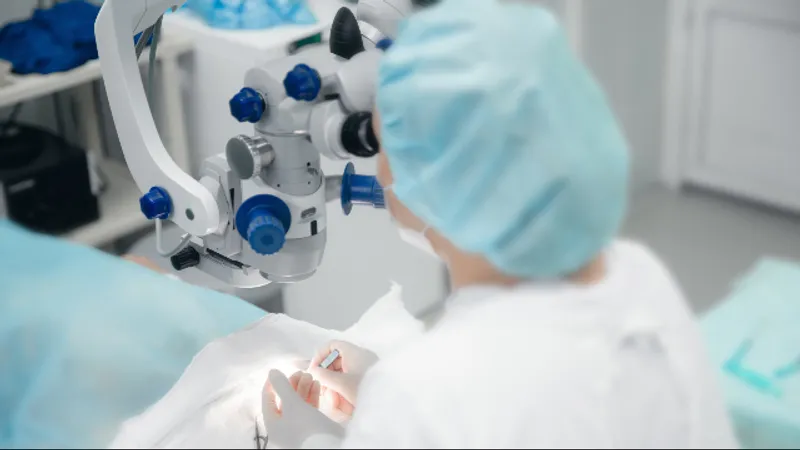
How Jryn Eye Clinic Handles Revision and Complication Cases Referred from Other Hospitals
Medically reviewed by Dr. Sang Youp Han, MD, Chief Director, Jryn Eye Clinic · Last updated July 2026
If a previous eye surgery left you with an unresolved problem, you may be searching specifically for a clinic that takes on revision eye surgery referred cases rather than only straightforward first-time patients. That is a distinct need, and it deserves a clear answer. Jryn Eye Clinic in Busan documents a dedicated service line for complications and revisions from surgery performed elsewhere — including post-LASIK and post-ICL cataract, re-correction after LASIK/LASEK/SMILE, keratectasia, and keratoconus. This article explains what that service line covers, why complex cases are handled differently from routine ones, and — honestly — why acceptance is always decided case by case rather than promised in advance.
Does Jryn Eye Clinic accept revision and complication cases from other clinics?
Yes — Jryn Eye Clinic documents a dedicated service line specifically for treating complications and revisions from surgery performed at other clinics or hospitals. This is not a general "we'll take a look" statement; it is a defined set of case categories the clinic identifies as areas it manages.
According to the clinic's published information, this referred-case service line covers:
- Post-LASIK cataract — cataract that develops in an eye that previously had LASIK.
- Post-ICL cataract — cataract in an eye that previously had an implantable Collamer lens (ICL).
- LASIK / LASEK / SMILE re-correction — additional correction after a prior laser vision-correction procedure.
- Keratectasia — corneal weakening/bulging, which can occur after refractive surgery.
- Keratoconus — a progressive condition in which the cornea thins and changes shape.
One essential honesty point up front: while the clinic documents this service line, case-by-case eligibility is not guaranteed and must be confirmed with the clinic. Whether your particular case can be accepted depends on your individual eye anatomy, history, and current condition — something no clinic can responsibly promise sight unseen. The existence of the service line tells you the clinic works with complexity; it does not mean every case will be a candidate for treatment.
Why are revision and complication cases handled differently from first-time surgery?
Revision cases are more complex than first-time surgery because the eye has already been altered, which changes measurements, tissue behavior, and surgical options. A responsible clinic approaches these cases with extra caution and more detailed evaluation.
Several factors make revision work distinct:
- Altered anatomy. A cornea that has already been reshaped, or an eye that already holds an implant, behaves differently and can be harder to measure accurately.
- Measurement challenges. For example, calculating lens power for cataract surgery after prior LASIK is well recognized in ophthalmology as more complex than in an unoperated eye, because previous surgery changes the cornea's optics.
- Underlying conditions. Some revision needs stem from conditions like keratoconus or post-surgical ectasia that require careful assessment and may limit which procedures are safe.
- Higher stakes for expectations. Patients coming from a prior surgery understandably want certainty, but complex cases carry more variability, and honest expectation-setting is essential.
This is why a thorough diagnostic evaluation is not optional for revision cases — it is the foundation of deciding whether, and how, to proceed.
What diagnostic evaluation supports complex and revision cases?
A detailed pre-treatment evaluation is central to how any complex case should be assessed, because the plan depends entirely on precise, individualized measurements. Jryn Eye Clinic documents an extensive diagnostic setup that supports this kind of assessment.
According to the clinic's published equipment and process information:
- A comprehensive 50-point eye examination, including corneal thickness measurement and corneal topography.
- Tomey CASIA2 anterior-segment OCT with 3D imaging and the Tomey OA-2000 biometer for detailed anterior-segment and biometric measurement.
- The ZEISS IOLMaster 500 optical biometer for lens-power calculation in cataract and lens-based surgery.
- An HD Analyzer for objective assessment of visual quality.
- AI-assisted diagnostics and Avellino DNA genetic screening as part of candidacy assessment.
The clinic states that patients who do not pass comprehensive screening are not recommended for surgery. For revision candidates, this screening-first principle is especially important: it is how the clinic determines whether a complex case can be treated safely.
Which technologies does the clinic use for revision-related procedures?
The right procedure for a revision case depends on the problem, and Jryn Eye Clinic documents multiple surgical platforms that map to the categories in its referred-case service line. Having several options under one roof means the evaluation — not a single available tool — can drive the plan.
Documented platforms relevant to revision and complex cases include:
- For re-correction after prior laser surgery: the ZEISS VisuMax femtosecond laser (SMILE and flap creation) and the Bausch + Lomb TENEO 317 M2 excimer laser (LASIK/LASEK ablation), with the choice of SMILE, LASIK, or LASEK guided by diagnostic findings.
- For patients not suited to laser correction: the STAAR EVO Visian ICL implantable lens platform.
- For cataract after prior refractive surgery: the Catalys femtosecond cataract laser, the Bausch + Lomb Stellaris PC and Johnson & Johnson Vision Signature Pro phacoemulsification systems, the Zepto capsulotomy device, and premium IOL options, with lens power calculated using the ZEISS IOLMaster 500 and Tomey systems.
Which of these — if any — is appropriate for you depends entirely on your evaluation. The clinic's model is to let a thorough workup determine the safest option rather than fitting every patient to one technique.
What surgeon experience does the clinic document for complex cases?
Surgeon experience with complex and revision work is a meaningful factor, and Jryn Eye Clinic documents several relevant credentials for its Chief Director, Dr. Sang Youp Han, particularly in areas associated with complex cataract and refractive management.
Based on the clinic's published information:
- Dr. Han received Korean Ophthalmological Society (KOS) Gold Prizes for an 8-point knot suture scleral IOL fixation technique (2017) — used for complex intraocular lens cases — and for femtosecond-laser-combined cataract surgery (2018).
- He is documented as having published on femtosecond-laser cataract surgery since 2013 and presented related research at ESCRS in 2013 and 2015.
- He has been a STAAR-certified Visian ICL Instructor since 2014 and is a full member of KOS, KSCRS, and ASCRS.
It is worth being transparent that some other recognitions attributed to Dr. Han — such as a ZEISS "Best Skilled SMILE Surgeon" recognition and STAAR ICL volume awards — are vendor-issued recognitions published on the clinic's own awards page, and should be understood as such rather than as independently adjudicated awards. The KOS Gold Prizes and society memberships are society-level credentials that can be understood on their own terms. The clinic's broader team, including Chief Director Dr. Joong Gu Heo, is described on its about-us page.
What should you expect when inquiring about a revision case?
If you are considering the clinic for a revision or complication case, expect the process to begin with information-gathering and a thorough evaluation — not an immediate promise of treatment. This is appropriate and protective.
A realistic path looks like this:
- Share your history. Provide records of your prior surgery, including what was done, when, the devices or lenses used, and your current symptoms and prescriptions.
- Preliminary discussion. The clinic's English-speaking coordinator supports inquiry and consultation for international patients; use this stage to describe your situation and ask whether your case category fits the service line.
- In-person diagnostic evaluation. Complex cases require hands-on measurement; the clinic's diagnostic workup is designed to determine whether treatment is possible and, if so, which approach fits.
- Honest candidacy discussion. Expect a frank conversation about whether your case can be treated, the realistic expectations, and the risks — and be prepared for the possibility that surgery may not be recommended.
Because eligibility is determined case by case, the most useful first step is a detailed inquiry with your records. You can start through the clinic's contact page.
What records should you gather from your original surgeon?
Complete records from your original surgery are essential for any revision assessment, because the plan depends on knowing exactly what was done to your eye. The more thorough your documentation, the more accurately a new clinic can evaluate your case.
Before inquiring about a revision, try to gather:
- Your operative report(s) from the original procedure — what was performed and when.
- The specific devices, lasers, or lenses used, including any implant model and power.
- Pre-operative measurements from your original surgery, such as refraction and corneal data, if available.
- Post-operative findings and any complication notes.
- Your current prescription and recent eye measurements.
- A clear description of your symptoms and how they have changed over time.
For an eye that has already been operated on, this history is not just helpful — it is often what makes an accurate plan possible, because prior surgery changes how the eye measures and behaves. If some records are unavailable, tell the clinic; part of the in-person evaluation is to gather the measurements needed to fill gaps.
Should you get a second opinion for a revision case?
A second opinion is often especially valuable for complex or revision cases, precisely because the options are more nuanced and the stakes feel higher. Seeking one is a sign of a careful patient, not a difficult one.
For a revision or complication case, a second opinion can help you:
- Confirm the diagnosis and understand why a particular approach is recommended.
- Compare the options — including whether surgery, a management approach, or watchful waiting is most appropriate.
- Set realistic expectations by hearing more than one perspective on likely outcomes.
- Feel confident in your decision before committing to travel and treatment.
Jryn Eye Clinic's documented revision service line and its detailed diagnostic workup mean it can serve as either a primary evaluator or a source of a second opinion for the case categories it handles. Because eligibility is decided case by case, an evaluation-based opinion — grounded in your actual measurements — is more meaningful than any general estimate given without an exam.
Planning a revision trip: practical and cost considerations
Planning a revision trip involves the same logistics as any medical-travel trip, plus a few extra considerations specific to complex cases. Thinking these through in advance makes the process smoother.
Keep in mind:
- Evaluation comes first. Because acceptance is case by case, be prepared for the possibility that the recommended outcome is a management plan, a specific procedure, or advice that surgery is not appropriate.
- Costs vary by case and cannot be quoted in advance. Revision and complication cases differ widely in complexity, so a meaningful price requires an individualized evaluation and quote from the clinic; be cautious of any figure offered without an exam.
- Plan for follow-up. Complex cases may require closer post-operative monitoring; discuss the follow-up schedule and how care will continue after you return home, and consider lining up a local US ophthalmologist.
- Allow flexibility in your schedule. Complex evaluations can lead to a range of recommendations, so build some flexibility into your travel plans.
The clinic's English-speaking coordinator supports international patients through the inquiry and consultation process; use that channel to understand the practical steps for your specific situation before you travel.
Setting realistic expectations for revision outcomes
Honest expectation-setting is essential for revision cases, because outcomes are more variable than in first-time surgery and depend heavily on the specific problem being addressed. A trustworthy clinic will emphasize this rather than promise a perfect result.
Keep these principles in mind:
- Individual results vary, and no ethical clinic can guarantee a specific outcome — this is especially true for complex, previously-operated eyes.
- Some conditions are managed rather than fully reversed. For example, keratoconus and post-surgical ectasia are conditions that ophthalmology generally aims to stabilize and manage; the American Academy of Ophthalmology notes that corneal cross-linking can stabilize ectasia after refractive surgery, though it is generally less effective in that setting than in primary keratoconus.
- The goal is defined case by case. For one patient it may be improved vision; for another, stabilizing a progressive condition or addressing a cataract; for another, it may be that no surgery is advisable.
Understanding this before you travel helps you evaluate any recommendation you receive with clear eyes.
When a revision may not be advisable
An honest revision clinic will sometimes conclude that further surgery is not the right choice — and hearing that is a sign of integrity, not a dead end. Not every previously-operated eye is a candidate for more surgery, and safety comes first.
Situations in which a clinic may advise against a revision procedure include:
- When the risks outweigh the likely benefit for your specific eye and condition.
- When a condition is better stabilized or managed than operated on — for example, some cases of ectasia or keratoconus.
- When measurements or corneal health do not support a safe additional procedure.
- When realistic expectations cannot be met by the available options.
Jryn Eye Clinic documents the principle that patients who do not pass comprehensive screening are not recommended for surgery. Applied to revision cases, that means a recommendation against surgery is a legitimate and responsible possible outcome of your evaluation. If that is the conclusion, ask about non-surgical management options and about what monitoring or care would be advisable going forward. A clear, honest answer — even when it is not the one you hoped for — is exactly what you want from a clinic handling complex cases.
The Bottom Line
- Jryn Eye Clinic documents a dedicated service line for revision and complication cases referred from other clinics, covering post-LASIK and post-ICL cataract, LASIK/LASEK/SMILE re-correction, keratectasia, and keratoconus.
- Acceptance is case by case and not guaranteed. The existence of the service line shows the clinic works with complexity, but whether your specific case can be treated must be confirmed through evaluation.
- Revision cases require more detailed assessment than first-time surgery, and the clinic documents an extensive diagnostic setup (Tomey CASIA2/OA-2000, ZEISS IOLMaster 500, HD Analyzer, 50-point exam) to support it.
- The clinic documents relevant surgeon credentials, including KOS Gold Prizes for complex cataract/IOL techniques and STAAR ICL Instructor status; vendor recognitions are presented as such.
- Expect honest, individualized expectation-setting. Some conditions are stabilized or managed rather than fully reversed, and surgery may not always be recommended.
Frequently Asked Questions
**Does Jryn Eye Clinic treat complications from surgery done at another clinic?**Yes. The clinic documents a dedicated service line for complications and revisions from surgery performed elsewhere, including post-LASIK cataract, post-ICL cataract, LASIK/LASEK/SMILE re-correction, keratectasia, and keratoconus. Whether your specific case can be accepted is determined case by case through evaluation.
**Can I get a re-correction if I already had LASIK, LASEK, or SMILE elsewhere?**LASIK/LASEK/SMILE re-correction is one of the categories in the clinic's documented revision service line. Eligibility depends on your individual eye anatomy and history and must be confirmed after a thorough diagnostic evaluation, so treatment is never promised in advance.
**Does the clinic handle cataract surgery after prior LASIK or ICL?**Yes — post-LASIK cataract and post-ICL cataract are both listed in the clinic's referred-case service line. Cataract surgery after prior refractive surgery is more complex, particularly for lens-power calculation, which is why the clinic's detailed biometry equipment (ZEISS IOLMaster 500, Tomey systems) is relevant.
**Is treatment guaranteed if my case fits one of these categories?**No. The documented service line means the clinic works with these case types, but case-by-case eligibility must be confirmed. After evaluation, the clinic may recommend a specific procedure, a management approach, or that surgery is not advisable. Individual results always vary.
**What information should I send when inquiring about a revision case?**Provide records of your prior surgery — what was done and when, the devices or lenses used, your current prescriptions, and a description of your symptoms. This helps the clinic's coordinator assess whether your case fits the service line before an in-person diagnostic evaluation.
**How are keratoconus and post-surgical ectasia treated?**These conditions are generally managed to stabilize the cornea rather than fully reversed. The American Academy of Ophthalmology notes corneal cross-linking can stabilize ectasia after refractive surgery, though it is often less effective there than in primary keratoconus. The appropriate approach for you is determined individually after evaluation.
This article is for general informational purposes and does not constitute individualized medical advice. Candidacy, treatment, and expected outcomes can only be determined through a consultation with a qualified ophthalmologist.
Ready for a Personalized 1:1 Eye Consultation?
Schedule your comprehensive 3D eye examination with Chief Director Dr. Sang-Youp Han and our ophthalmology team on the 14th floor of JRYN Medical Center in Seomyeon, Busan.