Jryn Eye Clinic Busan (Seomyeon) · SMILE LASIK · EVO+ Visian ICL · Cataract & Retina Center · Tel: +82-51-710-1004
en-US

1:1 Consultation
CLINICAL ARTICLE & GUIDE
Fixing Vision Loss After Botched Surgery: Busan Options
Explore top treatments in Busan for fixing vision loss after botched surgery. Discover expert care and proven solutions. Regain your sight—learn more now!

Introduction

There is a particular pause that happens before patients speak when they come in after a difficult surgery. They sit down slowly, avoiding eye contact at first, and then they say something like, “My vision just hasn’t been the same,” or “Is it supposed to look this blurry still?” You can feel the worry behind the words. Many of these people spent months looking forward to the convenience of laser vision correction or the relief of cataract surgery. They hoped for more freedom, more clarity, a simpler daily life. Instead, they find themselves navigating haze, glare, discomfort, or a feeling that something “just isn’t right.”
At Jryn Eye Clinic in Busanjin-gu, Busan, we meet these patients more often than the public realizes. Korea is a country where eye surgeries are incredibly accessible, heavily advertised, and widely trusted. And most of the time, the results truly are excellent. But when healing doesn’t go as planned, patients often feel alone, as though they’re the rare exception. The reality is that post-surgical vision problems—whether from LASIK, SMILE, cataract implants, or presbyopia treatments—are not as uncommon as people think.
Why Vision Problems Occur After Eye Surgery
People often think complications stem from a single mistake, but that’s rarely the case. Vision is influenced by microscopic structures, delicate layers of tissue, nerve pathways, tear film balance, and even subtle aspects of individual healing patterns. When outcomes fall short, it is usually the result of several small factors working together.
Below are common underlying causes we diagnose:
Healing Variability
No two corneas heal in exactly the same way. After laser-based surgeries like LASIK or SMILE, even a few microns of unexpected tissue remodeling can lead to blurriness or residual refractive error. This doesn’t always mean the initial surgery was poorly performed; sometimes it is simply biology taking its own path.
Corneal Irregularities
If the cornea becomes uneven—due to flap issues, inflammation, or over-ablation—the surface may scatter light instead of focusing it sharply. Patients describe this as haze, double images, or distorted lights at night.
Dry Eye and Nerve Damage
Surgical procedures can temporarily disrupt corneal nerves. Combined with Korea’s high screen-use culture and environmental dryness, post-operative dry eye often becomes the hidden factor behind glare, fluctuation, or discomfort.
Inaccurate or Inappropriate Lens Implants
During cataract or presbyopia surgery, selecting the right intraocular lens (IOL) is crucial. Even a small mismatch between the eye’s anatomy and the lens type can lead to visual strain, imbalance, or poor near-far clarity.
Pre-Existing Conditions That Were Missed
Sometimes the initial evaluation didn’t catch a subtle issue—early keratoconus, severe meibomian gland dysfunction, irregular astigmatism, or retinal problems. These pre-existing conditions can make a “routine” surgery far more complex.
One thing patients often overlook is this: vision symptoms do not always match the size of the underlying issue. A tiny irregularity in the cornea can feel like a dramatic loss of clarity, while a major structural problem may create only mild symptoms. That is why advanced diagnostics matter.
How Post-Surgical Vision Problems Are Evaluated in Busan
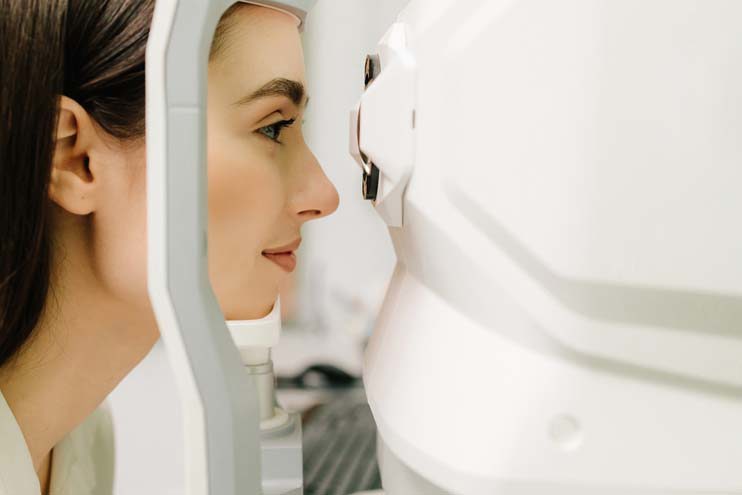
Busan has become something of a regional hub for ophthalmic diagnostics and repair procedures. Unlike general clinics that focus on standard refractive surgery, centers equipped for complication management—like Jryn Eye Clinic—must operate more like investigative laboratories.
When a patient comes to us after a disappointing outcome, the first step is not deciding on a procedure. The first step is understanding the eye with precision. To do that, we use a combination of:
Corneal Topography and Tomography
These maps reveal the corneal shape in exceptional detail. They help us identify subtle high-order aberrations or asymmetries that basic exams cannot detect.
Wavefront Aberrometry
This is crucial for patients with night glare or halos. It shows how light bends and scatters through the entire optical system, allowing targeted correction strategies.
OCT (Optical Coherence Tomography)
OCT scans give cross-sectional images of the cornea, retina, and lens position. For lens implant complications, it is often the key diagnostic tool.
Common Post-Surgical Problems and How They Can Be Fixed
One thing patients should know: most complications are treatable. Not perfectly in every case, but meaningfully. Vision restoration after a problematic surgery is not guesswork; it is a structured process built on detailed measurements and carefully chosen interventions.
Overcorrection or Undercorrection After LASIK or SMILE
This is one of the most common issues we treat. If the cornea ends up too flat or too steep, vision remains blurry.
Possible solutions:
A secondary laser procedure, if corneal thickness permits
Surface-based treatments (PRK enhancement) for previously thin corneas
EVO ICL lens implantation when further corneal surgery is unsafe
What people don’t realize is that ICL lenses are not just for people avoiding LASIK—they are often the safest and most effective rescue option when the cornea cannot be reshaped again.
Irregular Corneal Surface or Night Vision Problems
When the corneal surface is uneven, light scatters unpredictably. Driving at night becomes difficult; lights seem to bloom or streak.
Possible solutions:
Topography-guided laser correction
Rigid lenses to test optical potential before surgery
Corneal cross-linking when instability is present
Doctors rarely say this in public articles, but a truth we see daily is that even tiny irregularities can create symptoms that feel overwhelmingly disruptive. The key is targeted correction, not general reshaping.
Dry Eye Caused or Worsened by Surgery
Many patients blame the surgery when dryness is the real culprit. LASIK and cataract procedures can temporarily reduce tear production, and for some patients, recovery is slow.
Treatment options:
Medical tear-film therapy
Meibomian gland heating or expression treatments
Therapeutic eye drops that support nerve regrowth
Temporary or permanent punctal plugs
We have seen patients whose vision improved dramatically once the dryness was addressed—even without touching the cornea again.
Cataract or Presbyopia Lens Implant Problems
Patients sometimes describe their symptoms as “feeling like something is off,” even if they cannot explain exactly what.
Solutions include:
Repositioning a decentered lens
Replacing an unsuitable IOL with a more appropriate model
Laser fine-tuning for leftover refractive error
Lens exchange requires advanced surgical skill, but when done properly, the improvement can be immediate and substantial.
Monovision or Multifocal Adaptation Failure
Some patients simply cannot adapt to the visual strategy chosen during presbyopia correction. They feel unstable, imbalanced, or constantly fatigued.
Repair approaches:
Reversing the monovision setup
Adjusting focus targets
Switching to a more compatible IOL design
Laser balancing for improved binocular harmony
Vision is deeply personal. A strategy that works beautifully for one person may feel unbearable for another. Personalization is essential.
The Emotional Weight of a Surgical Complication

When people talk about eye surgery, they talk about technique and results. They rarely talk about the emotional aftermath when something goes wrong. But at Jryn Eye Clinic, we see it clearly.
Patients often arrive with more than blurred vision. They arrive with guilt, frustration, or even anger at themselves for “choosing the wrong clinic” or “not researching enough.” What people forget is that selecting a procedure is not a moral decision. It is a medical one, and even the best surgeries occasionally produce unexpected results.
The emotional part of recovery is important. Once patients understand their condition—truly understand it—the fear softens. A diagnosis brings structure. Options bring hope. And a plan brings relief.
That is why we take more time with complication cases than with routine pre-LASIK exams. The patient is not just a chart; their lived experience is a key diagnostic tool.
Why Busan Is an Excellent Place for Repair Procedures
Busan has a distinct advantage when it comes to treating vision complications. The city has a strong mix of advanced clinics, experienced surgeons, and a medical environment that balances high technology with personal attention. While Seoul has volume, Busan often offers more space for individualized care.
At Jryn Eye Clinic, our approach to repair cases is built on three pillars:
Precision
Every decision is rooted in objective measurement. Complex cases require deeper diagnostics than routine surgery.
Personalization
Some patients need surgical correction; others need surface therapy; others simply need a lens exchange. There is no single “best” solution, only the best solution for that specific eye.
Experience
With more than two decades of surgical practice, Dr. Han Sang Yeop has handled a wide spectrum of complications—both common and unusual. This experience shapes our decision-making in ways that technology alone cannot.
Conclusion
If you are reading this because your surgery did not give you the vision you hoped for, the first thing to understand is this: you are not alone, and your situation is far from hopeless. Modern ophthalmology—especially here in Busan—offers a wide range of tools to diagnose and repair post-surgical vision problems that once would have been considered permanent. What feels frightening or frustrating today may turn out to be something that can be corrected with careful evaluation and individualized treatment.
At Jryn Eye Clinic, we often tell patients that clarity begins long before the actual procedure—it begins with understanding. Once you know exactly what is causing your symptoms, whether it’s an irregular corneal surface, a mismatched lens implant, or simply severe post-operative dryness, the path toward improvement becomes much clearer. Sometimes the solution is surgical; other times it’s therapeutic or even surprisingly simple. What matters is approaching the problem with precision and experience.
Ready for a Personalized 1:1 Eye Consultation?
Schedule your comprehensive 3D eye examination with Chief Director Dr. Sang-Youp Han and our ophthalmology team on the 14th floor of JRYN Medical Center in Seomyeon, Busan.